Share
Save
Ready
Many homeowners frequently enquire, 'What is the total cost of Home Elevators in Bangalore?’ when considering this option.
The total cost of elevators will depend on several things, such as what type of elevator technology will be used, how many floors and/or levels will be serviced by the elevators, how much customisation is going to be done for the elevators, and how complex the installation of the elevators will be. The starting costs for residential elevators purchased in Bangalore in 2026 will be around ₹14.5 lakhs, depending on the specific model, make and configuration of the elevator.
This guide will help you understand your options, the starting prices of some of the Elite Elevators models offered for sale in India, what factors will affect the overall installation cost, as well as how to effectively plan your finances for the purchase of a Residential Elevator.
In Bangalore, residential architectural styles have changed dramatically over the last 10 years. A majority of homes now generally follow G+1 (ground plus one), G+2 (ground plus two), and G+3 (ground plus three) architectural styles, especially in the premium neighbourhoods or the standalone villa areas of the city. This vertical expansion creates a demand for elevators because they provide the following benefits:
• Better accessibility for elderly family members
• Smooth movement from one floor to another
• A higher resale value for property
• Greater architectural sophistication
• Long-term convenience for multi-generational families
As homes in cities like Bangalore get taller, installing a home elevator is increasingly recognised as a future-ready investment in infrastructure rather than simply a luxury upgrade.
It's Time to Install a Premium Home Elevator With Elite Elevators
The cost of an elevator for your home will vary based on your preferred style and features. The Elite Elevator group has several different types of residential elevators available to fit your needs, including villas, townhouses, and independent homes.
Below are prices for some of the most popular models offered by Elite Elevators in India (with a price range from G+1)
| Model | Starting Price (G+1 Configuration) |
|---|---|
| X200 | ₹14,50,000 |
| X200 Plus | ₹16,75,000 |
| X300 MK II | ₹18,70,000 |
| X300 MK II Plus | ₹20,95,000 |
| E200 Standard | ₹26,80,835 |
| E200 Elegance | ₹34,98,065 |
| E300 Standard | ₹48,23,740 |
| E300 Elegance | ₹53,71,652 |
| E50 Stairlift | ₹13,41,180 |
Prices represent starting estimates and may increase depending on additional floors, cabin customisation, and installation requirements.
One of the main factors that can affect the price of a residential elevator in India, specifically in Bangalore, is how many floors will be served by the lift.
When you install a residential elevator, it is generally set up as follows:
As more floors are added, the elevator system requires adjustments to support the greater travel height. This includes extending guide rails, installing additional landing doors, configuring control systems, and ensuring accurate installation setup for reliable operation.
If you compare the cost of a G+1 vs a G+2 elevator, you will see that the price of both elevators will start out very close to one another, but each time you add an additional stop, you must add more landing doors and extend the guide rails, which eventually drives the cost of installation up.
The additional travel distance between the G+2 vs G+3 elevators will require considerable additional height and structural alignment.
Residential elevators can generally be divided into two categories of drive system: hydraulic and gearless. The type of drive system chosen will affect the functionality and cost of the elevator.
Hydraulic elevators function similarly to pistons. They have the following benefits:
Gearless home elevators use advanced technology that has been developed to allow for low noise and minimal vibration during operation. The benefits of using gearless elevators for residential purposes are:
Therefore, gearless elevators are primarily used in luxury residences because of their engineered design that enhances the passenger experience.
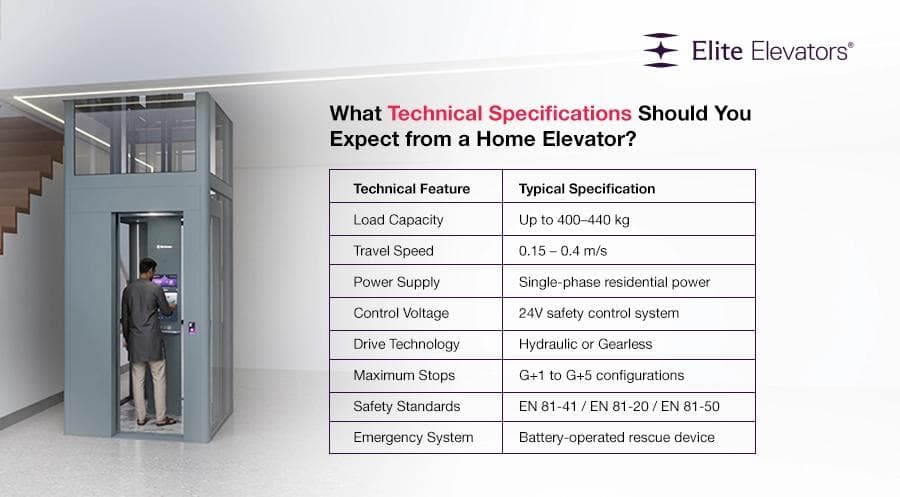
| Technical Feature | Typical Specification |
|---|---|
| Load Capacity | Up to 400–440 kg |
| Travel Speed | 0.15 – 0.4 m/s |
| Power Supply | Single-phase residential power |
| Control Voltage | 24V safety control system |
| Drive Technology | Hydraulic or Gearless |
| Maximum Stops | G+1 to G+5 configurations |
| Safety Standards | EN 81-41 / EN 81-20 / EN 81-50 |
| Emergency System | Battery-operated rescue device |
The final installation cost of a home lift may differ from the base price due to various elements.
The quantity of landings directly affects the travelling height of the lift, the length of the guide rails and the installation of the doors at each of the landings.
The hydraulic and gearless lifts have different engineering complexity and ride characteristics; as a result, there can be a considerable difference in the installation cost for the same number of levels in these two types of lifts.
Many homeowners design their cabins with special interior features, including:
These upgrades to the design of the cabin enhance the appearance of the lift, but they can also increase the total installation cost.
Residential elevators require an elevator shaft to be built within the structure of the home in order to support the elevator. Therefore, additional building work may be required depending on how the home is laid out.
The time and cost associated with the installation of the elevator may be affected by other factors, including routing of electrical wiring, the centre alignment of the elevator shaft, and installation calibration.
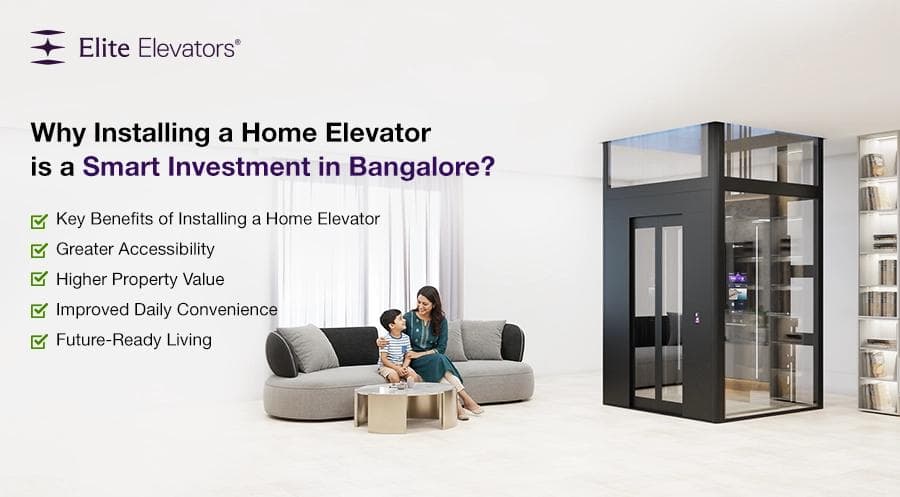
Home elevators offer several advantages beyond everyday convenience. Some of the key benefits include:
Home elevators make it easier for elderly residents and individuals with limited mobility to move comfortably between floors.
Homes with elevators are often considered more desirable in the Bangalore real estate market, helping increase overall property value.
Elevators simplify everyday activities such as carrying groceries, luggage, or laundry between floors.
Installing a home elevator supports long-term accessibility, allowing homeowners to continue living comfortably as their needs change over time.
A site visit is the only way to get an accurate price for your home's layout and floors
Since every home has a unique layout, the most accurate pricing is typically determined through a site inspection.
The process usually includes:
An elevator consultant visits the property to assess structural feasibility and installation space.
Homeowners can discuss:
Based on the site inspection and chosen specifications, a detailed quotation is provided.
When selecting a residential elevator provider, homeowners should evaluate several factors beyond price.
Important considerations include:
Choosing a reputable provider ensures that the elevator performs safely and reliably over the long term.
As of 2026, the price of a house elevator in Bangalore starts around ₹14.50 lakh for an entry-level G+1 model. Prices for mid-range premium home elevators are usually between ₹18 and 21 lakhs; however, prices for luxury residential elevating devices may exceed ₹48 lakhs depending on configuration and customisation.
How much an individual will spend depends on many factors, including but not limited to:
Homeowners must take into account more than just the price when choosing an elevator. Other factors that should affect the homeowner's choice of an elevator include safety, reliability, and usability for many years to come once installed.
As Bangalore continues to grow vertically, installing a home elevator in your home is becoming a smart home improvement for the future.
Choose Between Hydraulic & Gearless — Both Trusted, Both Certified, Different Prices.
A residential elevator starts at approx. INR 14,50,000 for a G+1 configuration, depending on the type of model installed.
Yes, since additional floors will require longer guide rails and additional landing doors, as well as travel height, therefore your costs will increase for each additional floor.
Yes. Home elevators can be installed in existing homes if adequate space is available for a properly constructed lift shaft. With proper structural planning and site evaluation, residential elevators can be integrated into many existing multi-storey homes.
The installation time will greatly depend on your job site and structural readiness. Most residential elevators can be installed within 2-3 weeks after all civil work has been completed.
Yes. A home with a residential elevator generally has a greater resale value and is thought of as being more accessible to individuals with disabilities and being long-lasting for the installing homeowners.
Anika is a Research & Development Specialist at Elite Elevators, India’s trusted brand for premium home elevator solutions. She specializes in residential elevator technology, space-efficient mobility solutions, and user-focused elevator innovations designed for modern Indian homes. Working closely with global engineering teams, Anika contributes to bringing advanced European elevator technologies to homeowners across India. Through her articles, she shares practical insights on home elevators, safety, design, installation, and smart mobility trends to help readers make informed decisions.


